






Interview With Mare Edstrom
January, 2004 By Liam Edwards
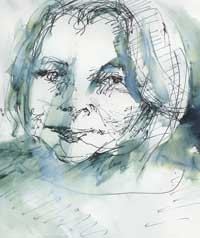
Drawing by Raj Alwa
Waterford, WI - Lifelong musician and songwriter Mare Edstrom will be releasing her first solo album in 2004. When we talked in January much of the album had already been recorded. Her petite stance understates her strength of body and mind. While always the artist, her week includes soul centering sessions of yoga, kick boxing and circuit training. She is classically pretty, often even cute and charming, but not affected or "girly." She comes off as a complex woman who is surprisingly direct, passionate and authentic. Like many artists, she phases between the parallel universes of spirit and logic.
LE: It has been a busy year for you working on a variety of Spiritone projects. How did you get involved with Spiritone?
Mare: Yes, it's been kind of an intense year. Everything with Spiritone's happened relatively fast. It all started when I found Kenn on the Internet. I was searching for a fingerstyle/blues guitar teacher, so I enrolled in lessons with him at Hartland Music in December of 2002. I also decided to pick up pop/jazz voice lessons at the same time with Barbara Stephan. Before Hartland Music, I had been writing songs and trying to record them at home, mostly on piano. It was slow-going at best. I was trying to improve my guitar skills so I could feel better about the enigmatic idea I had of playing coffeehouse-type gigs alone. I hadn't been performing at all for a few years, and I needed something to boost my confidence. Kenn provided that in a big way when I started to apply the open tuning skills I was learning to my own songs. He seemed pretty excited the first time he heard me sing. I didn't really get it, but I liked it. From that point on, Kenn's focus in lessons shifted from teaching me guitar to producing me as a singer-songwriter.
By about February 2003, he had asked me to contribute a song to the "One on One" project, which thrilled me. In May, we began to record some of my material at Randy's studio. This was a whole new learning process. In July, Kenn and I started co-writing for my solo album, and by October, we were back in the studio helping Fred and Ethel with their album. Now it's January of 2004, and not only have we finished or nearly finished four Spiritone album projects and formed a duo, but I have joined the business side of the record company, and I've started performing again, including my debut at the Cafe Carpe with Eric Taylor.
This year looks to be equally exciting and busy, as Kenn and I are making plans to hit the folk festival circuit this summer and record a blues album after we finish both of our current solo albums. In one year, music has evolved from a source of frustration I couldn't escape, to an actual career that has provided me hope, friendship, and a positive outlet for expressing my somewhat extreme emotions. I'm grateful for that.
 LE:Your
background includes an eclectic range of performance art. You performed as a singer and on piano from an early age, studied classical music in
college while playing in a rock band, you acted in musical theater for a while, in recent years you have focused on songwriting and recording.
Were you going through different phases as an artist or were you always searching for the correct medium?
LE:Your
background includes an eclectic range of performance art. You performed as a singer and on piano from an early age, studied classical music in
college while playing in a rock band, you acted in musical theater for a while, in recent years you have focused on songwriting and recording.
Were you going through different phases as an artist or were you always searching for the correct medium?
Mare: I think both, and neither. It's taken me awhile to find myself as a person and especially as an artist. I spent a lot of my life trying to be what everyone else wanted me to be, without having a good understanding of what I wanted to be, or what suited me. I've tried many different paths, partially succeeded, and then failed or quit, often very discouraged. A lot of the musical phases I went through really didn't suit me at all, like classical music, for example. Yet I could do a convincing impression of an opera singer and concert pianist...and those who were around me at the time believed that was where I belonged. I was convinced for awhile, too. But in time I realized that I was uncomfortable with it, and it didn't make me happy to do music that way. Pop and country music weren't much better for me. It's taken most of my adult life to connect to my own musical soul. Blues has long been one point of connection; popular singer-songwriters were another. I realize now part of my problem was not educating myself well enough on the vast range of early and independent artists in the styles I liked. I'm still working on that, and on defining my own style--does that ever stop for an artist? I doubt it. But I will say that I've learned valuable lessons from all of the phases I've been through...and I've always kept searching.
LE:People are often surprised to find that you have degrees in math and physics. How does this background influence you as an artist?
Mare: Yes, I have a degree in math and physics education, and I studied electrical engineering for a couple of years, as well as music and French. College took me a while to complete, because it was almost like I kept flipping between my right and left brains as I'd get burnt out on one or the other. I hope these days both sides are working together more happily. I'm at my best as an artist, and as a person in general, when I can think and feel simultaneously, which, strangely enough, is hard for me. Music theory is very mathematical and I love it for that reason, and my physics background helps me understand sound and the digital and analog recording processes...but there comes a point when I have to let go of my knowledge and sing (or play) from my gut. Then it becomes all heart, all feeling, raw creativity. My tendency at that point is to completely shut off my thinking, but then I start to forget words, chords and technique, and I wind up over-singing and messing up. So that's always my challenge, to stay in balance and put as much of both my heart and my mind into the music as I can simultaneously. It's work for me to do that, but it's rewarding when it's all happening together.
 LE:Your
first recording with Spiritone is the song "I" on One
on One. Can you give us a little background about this song?
LE:Your
first recording with Spiritone is the song "I" on One
on One. Can you give us a little background about this song?
Mare: My brother-in-law, Eric, first played me "I" back in 1993, when we were working on an album project for our band. He has a beautiful voice, and I remember weeping spontaneously. I don't cry much, and I'm not sure I've ever had that response to a song before or since. The song went straight into my heart and never left; it became a part of me. Eric wrote most of the songs for that album, but for some reason we decided not to use "I". I performed it live on piano after that, as Eric had first done, and I made it a priority to record it as soon as I could find a way. It took me awhile to actually accomplish that. Once I started guitar lessons, it was one of the first songs I adapted to open tuning. The performance on "One on One" was recorded to DAT in my living room, using my Shure KSM32 vocal mike and a single SM58 on the guitar. It was meant to be a studio demo. It was about the 15th take and I was exhausted. But something pure and special clicked that time, and we decided not to redo it in the studio. The song seems to have an effect on other people similar to the effect it first had on me, and I'm glad about that.
 LE:
Earlier you mentioned to me that the songwriters featured on your new album have become key influences on your style. At this point, who are
your primary influences?
LE:
Earlier you mentioned to me that the songwriters featured on your new album have become key influences on your style. At this point, who are
your primary influences?
Mare: I'd say my main influences right now are Townes Van Zandt, Dar Williams, Greg Brown, Bessie Smith, Janis Joplin, Jimi Hendrix, and Bob Dylan. And of course Kenn.
LE: I got an advance listen to many of the tracks on your solo album. My first impression was that this is NOT a polite, pretty, acoustic based, singer/songwriter album. You dig into the historic roots of blues and rock. Was this what you set out to do?
Mare: That would imply that any of this has happened in a deliberate, calculated way. NOT. The whole process has felt like a [confused mess] much of the time to me, but in the end I feel that we've created the kind of music I like to hear, the kind that actually moves me personally the most. And I guess that's not always pretty--but neither is life, if you're really living it. You know?
LE: Some songwriters write quickly when inspiration strikes and others create a routine around the process. How do you approach song writing?
Mare: These days I seem to do songwriting well only when Kenn's sitting there "strongly encouraging" me. That's how we wrote "Half Mast," among others. Some of the best songs and poems that I've written alone in the past, like the lyrics for "Spirits in the House," came from spontaneous, intense inspirations. Most of the material I've tried to come up with in a more disciplined way has pretty much sucked. But then I'm still trying to create a routine around doing laundry...
LE:Tell me about the song "Half Mast." There seems to be several layers of meaning to the lyric. Is there an explanation you can share with us, or is this going to remain mysterious?
Mare: Kenn came up with the chorus and original concept for "Half Mast," kind of a blues piece from the perspective of an insane street preacher. I identified with the concept (scary, huh?), and liked the bluesy sound. I came back to our next songwriting session with two verses and a bridge, which Kenn eventually rejected as "chicky." (I didn't understand how bayonets could be chicky, but I try to trust his judgement on such matters.) We rewrote the final lyrics by stringing together random, biblical concepts. But the next day I realized that the result had actually formed an image of my own spiritual and emotional journey. I guess the details of that can remain a mystery. (And I do believe, by the way.)
 LE:
On Half Mast and many of the other songs, the instrumentation is mostly Kenn Fox guitars - acoustic, electric, slide, feedback, e-bow, etc, etc.
There are a few organ and piano parts here and there, but they aren't as obvious. How do you approach fitting your vocals in among these layers
of guitars?
LE:
On Half Mast and many of the other songs, the instrumentation is mostly Kenn Fox guitars - acoustic, electric, slide, feedback, e-bow, etc, etc.
There are a few organ and piano parts here and there, but they aren't as obvious. How do you approach fitting your vocals in among these layers
of guitars?
Mare: Yes, Kenn is the King on my album, which is his prerequisite for producing any artist. Fortunately, I can't get enough of loud guitars, so it works for me. My voice is somewhat complex, and Kenn's guitar parts support it well, in my opinion. He adds them after we've tracked the basic rhythm guitar, drums, and voice, which we record simultaneously. I am awed by Kenn's creativity on guitar and on arrangements. I don't consider arranging one of my strengths, which is another reason why we make a good team--we have a clear division of labor. I can come up with many creative ideas, especially on lead and background vocals, but I haven't yet developed much discernment about what's "cool." I think I'm better at arranging appropriate keyboard parts. But at this stage, I generally have to rely on Kenn for making the judgements. He has a vast knowledge of the musical world and a highly developed sense of artistry, so I respect him a lot as a producer. My judgement is improving, though--so look out.
---///---
The album Learning How to Believe will be released in the spring of 2004. From my listening to the advanced mixes, I am sure it will be a great addition to the Spiritone collection.
--Liam